Thứ Ba, 21 tháng 8, 2012

Drakensberg rockjumper

Chaetops aurantius

Photo by Robert Wienand (Flickr)

Common name:
Drakensberg rockjumper (en); tordo-de-peito-alaranjado (pt); chétopse doré (fr); saltarrocas del Drakensberg (es); orangebrust-felsenspringer (de)


Taxonomy:
Order Passeriformes
Family Turdidae


Range:
This species is endemic to South Africa and Lesotho, being found in the highlands of Lesotho and the nearby mountain grassland regions of the Eastern Cape, KwaZulu-Natal and Free State Province.


Size:
These birds are 23-25 cm long and weigh 75-100 g.


Habitat:
The Drakensberg rockjumper is found in high altitude grasslands and rocky areas, typically at altitudes above 1.800 m.


Diet:
They are strictly insectivorous, taking grasshoppers, moths and insect larvae and pupae which they collect on the ground.


Breeding:
Drakensberg rockjumpers breed in August-February. They are monogamous and the breeding pair is sometimes assisted by 1-2 helpers. The nest is a large untidy cup made of grass and twigs and lined with soft rootlets, grass and hair. It is usually placed on the ground, well concealed by tufts of grass, an overhanging rock, or sometimes a small scrub. The female lays 2-3 white eggs, which are incubated by both sexes. There is no information on the length of the incubation and fledging periods, but the chicks are known to be fed by both sexes.


Conservation:
IUCN status - LC (Least Concern)
This species has a restricted breeding range, but the population is suspected to be stable in the absence of evidence for any declines or substantial threats.

Thứ Hai, 20 tháng 8, 2012

Toucan barbet

Semnornis ramphastinus

Photo by Tadeusz Stawarczyk (Internet Bird Collection)

Common name:
toucan barbet (en); capitão-tucano (pt); cabézon toucan (fr); tucán barbudo (es); tukan-bartvogel (de)


Taxonomy:
Order Piciformes
Family Capitonidae


Range:
This species is found along the western slopes of the Andes, in southern Colombia and northern Ecuador.


Size:
These birds are 19-25 cm long and weigh 85-110 g.


Habitat:
The toucan barbet is found in mountain evergreen forests, secondary forests, open woodlands and pastures, at altitudes of 1.000-2.400 m.


Diet:
They are mainly frugivorous, eating a wide range of fruits, namely Cecropia and Ficus, but will also eat termites and other insects when they come across them.


Breeding:
Toucan barbets breed in February-October. They live in small family groups of up to 6 birds, with an adult pair and young that help raising the new clutch. They nest in a tree cavity, where the female lays 2-3 eggs, which are incubated by all group members for 15 days. The chicks are fed by all group members and fledge 43-46 days after hatching, but only becomy fully independent 4 weeks later.


Conservation:
IUCN status - NT (Near-Threatened)
This species has a relatively small breeding range and is described as uncommon. The population is declining at a moderately rapid rate, due to illegal trapping for the international cage bird trade and habitat loss through intensive logging, human settlement, cattle grazing, mining and coca and palm cultivation.

Chủ Nhật, 19 tháng 8, 2012

Red-headed bunting

Emberiza bruniceps

Photo by Audevard Aurelien (Mango Verde)

Common name:
red-headed bunting (en); escrevedeira-de-cabeça-ruiva (pt); bruant à tête rousse (fr); escribano de cabeza roja (es); braunkopfammer (de)


Taxonomy:
Order Passeriformes
Family Emberizidae


Range:
This species is found breeding in central Asia, from southern Russia and Kazakhstan to northern Iran and Afghanistan. They migrate south to winter in India.


Size:
These birds are 16-17 cm long and have a wingspan of 25-28 cm. They weigh around 25 g.


Habitat:
Red-headed buntings are found in open habitats, such as grasslands and steppes, scrublands, semi-desertic areas and oasis, and also in arable land. They occur from sea level up to an altitude of 2.000 m.


Diet:
They feed on the ground, mainly eating seeds and other plant material, but during the breeding season insects and other invertebrates become an important part of their diet.


Breeding:
Red-headed buntings breed in May-July. The nest is a loose structure made of cereal stems and grasses, placed close to the ground in a dense or thorny shrub, vine or fruit tree. The female lays 3-6 eggs, which she incubates alone for 10-14 days. The chicks fledge 2 weeks after hatching.


Conservation:
IUCN status - LC (Least Concern)
This species has a very large breeding range. There is no information on population size, but the population is suspected to be stable in the absence of evidence for any declines or substantial threats.

Thứ Bảy, 18 tháng 8, 2012

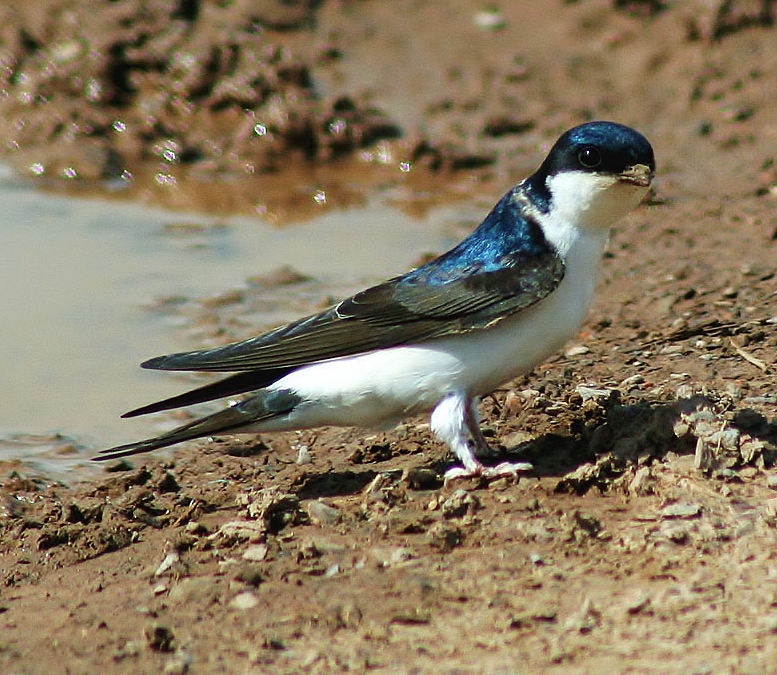
House martin

Delichon urbicum

(Photo from Wild About Britain)

Common name:
house martin (en); andorinha-dos-beirais (pt); hirondelle de fenêtre (fr); avión común (es); mehlschwalbe (de)


Taxonomy:
Order Passeriformes
Family Hirundinidae


Range:
This species breeds throughout most of Europe and the middle and northern latitudes of Asia, and also in north-western Africa and the Middle East. They migrate south to winter in Africa south of the Sahara, in the Red Sea coast and in south-east Asia.


Size:
These birds are 12-13 cm long and have a wingspan of 26-29 cm. They weigh 16-25 g.


Habitat:
House martins are mostly found in open habitats with low vegetation, namely pastures and grasslands, urban areas, agricultural areas and rocky areas. During winter they are also found over dry savannas. They can occur from sea level up to an altitude of 4.500 m.


Diet:
They mainly catch insects on the wing, taking flies, mosquitoes, flying ants, beetles, bugs, butterflies, mayflies, aphids and spiders.


Breeding:
House martins breed in March-June. The nest is a neat closed convex cup fixed below a suitable ledge, with a narrow opening at the top. The nests are made of mud and lined with grasses and fine materials. They often breed colonially with several nests built in contact with each other. The female lays 4-5 white eggs, which are incubated by both parents for 13-19 days. The chicks are fed by both parents and fledge 19-32 days after hatching. Each pair typically raises 2 broods per season.


Conservation:
IUCN status - LC (Least Concern)
This species has an extremely large breeding range and a global population of 60-290 million individuals. The population is suspected to be decreasing, and data from 21 European countries indicates a moderate decline since 1980.

Thứ Sáu, 17 tháng 8, 2012

Brown violet-ear

Colibri delphinae

Photo by Dusan Brinkhuizen (Sapayoa)

Common name:
brown violet-ear (en); beija-flor-castanho (pt); colibri de Delphine (fr); colibrí pardo (es)brauner veilchenohrkolibri (de)


Taxonomy:
Order Apodiformes
Family Trochilidae


Range:
This species is found in the mountains of Central America and western and northern South America, from Guatemala to Colombia and then south along the Andes to Bolivia, and east to Venezuela, the Guyanas and northern Brazil. There are also isolated populations in Trinidad and Tobago and in the Brazilian state of Bahía.


Size:
These birds are 11,5-12,5 cm long and have a wingspan of 15 cm. They weigh 6,5-7 g.


Habitat:
The brown violet-ear is mostly found in the canopy of rainforests but may also be found in second growth areas and coffee plantations. They are found at altitudes of 100-2.800 m.


Diet:
They mainly feed on the nectar of various trees and epiphytes, but will also take insects and spiders.


Breeding:
The brown violet-ear is polygamous, with the males gathering in leks to attract females and having no further part in the breeding process after the copulation. After mating, the female builds a cup-shaped nest made of soft plant down other fibres, held together with spider webs. The nest is placed in a scrub or tree, typically 1-4 m above the ground. There she lays 2 white eggs, which she incubates alone. There is no information about the length of the incubation period, but the chicks, who the female feeds alone, fledge 9-14 days after hatching.


Conservation:
IUCN status - LC (Least Concern)
This species has a very large breeding range and is described as common and patchily distributed. The population is suspected to be declining do to ongoing habitat loss.

Thứ Năm, 16 tháng 8, 2012

Black phoebe

Sayornis nigricans

Photo by Matthew Field (Wikipedia)


Common name:
black phoebe (en); papa-moscas-fibi-preto (pt); moucherolle noir (fr); mosquero negro (es)schwarzkopf-phoebetyrann (de)


Taxonomy:
Order Passeriformes
Family Tyrannidae


Range:
This species is found along the south-western coast of the United States, throughout Mexico and Central America and into South America, where it is found along the foothills of the Andes from Venezuela to northern Argentina.


Size:
These birds are 16 cm long and weigh 15-22 g.


Habitat:
The black phoebe is mostly found in open areas near water, around lakes, river, streams, channels and ditches. They are also found in rocky cliffs, scrublands and even within urban areas. This species occurs from sea level up to an altitude of 3.000 m.


Diet:
They are mainly insectivorous, taking beetles, grasshoppers, crickets, wild bees, wasps, flies, moths, caterpillars. They are also kwon to eat small fishes and small berries.


Breeding:
Black phoebes nest in open, semi-circular cups made of mud mixed with moss and grasses, and lined with feathers and hairs. The nest is plastered to a sheltered spot such as a crevice in a cliff face, bridge supports, culverts or walls, most often near water. The female lays 3-6 white eggs with a few faint speckles, which she incubates alone for 15-17 days. The chicks are fed by both parents and fledge 14-21 days after hatching. Each pair may raise 2-3 broods per year.


Conservation:
IUCN status - LC (Least Concern)
This species has a very large breeding range and the population is believed to be increasing overall. In North America the population has increased by 32% per decade over the last 4 decades. The black phoebe may benefit from many human activities, but destruction of riparian habitats and diversion of water is a concern.

Thứ Tư, 15 tháng 8, 2012

Black swan

Cygnus atratus

Photo by Rosie Perera (My Swan)

Common name:
black swan (en); cisne-preto (pt); cygne noir (fr); cisne negro (es); trauerschwan (de)


Taxonomy:
Order Anseriformes
Family Anatidae


Range:
This species originates from Australia, being mostly found in the southern and eastern parts of the country, including Tasmania. Since the 19th century the black swan has been introduced in New Zealand, Japan, western Europe and North America.


Size:
Black swans are 110-142 cm long and have a wingspan of 160-200 cm. They weigh 3,7-8,7 kg.


Habitat:
These birds are found in fresh water, salt water and brackish wetlands, including lakes, rivers and swamps, preferring areas with aquatic vegetation. They are also found in flooded fields and even in dry pastures when food is scarce.


Diet:
Black swans are mainly herbivorous, eating sub-aquatic foliage, namely of Typha, Potamogeton, Myriophyllum, Ruppia and various algae. They also eat plants on pastures and farm land and are known to occasionally eat insects.


Breeding:
Within their native range, black swans breed in February-September. They are largely monogamous and most often pair for life. Typically, the female builds the nest, a floating mound of sticks, dead leaves and debris, on shallow water or sometimes in small islands. There she lays 4-8 greenish-white eggs, which are incubated by both sexes for 35-48 days. The precocial chicks leave the nest 2-3 weeks after hatching and are able to feed themselves, but only fledge 5-6 months after hatching and may remain with their parents for even longer. During this period they are protected by their parents and in the first weeks they may even ride on their backs.


Conservation:
IUCN status - LC (Least Concern)
This species has a very large breeding range and the global population is estimated at 100.000-1.000.000 individuals. The population is suspected to be stable in the absence of evidence for any declines or substantial threats.