Hiển thị các bài đăng có nhãn Cracidae. Hiển thị tất cả bài đăng

Thứ Hai, 29 tháng 4, 2013

Black curassow


Crax aleactor

Photo by Patrick Ingremeau (Oiseaux)

Common name:
black curassow (en); mutum-poranga (pt); hocco alector (fr); paujil negro (es); glattschnabelhokko (de)

Taxonomy:
Order Galliformes
Family Cracidae

Range:
This species is found in northern South America, from central Colombia and Venezuela, through the Guyanas and intro Brazil north of the Amazon river.

Size:
These birds are 85-95 cm long and weigh 3,2-3,6 kg.

Habitat:
The black curassow is found in tropical rainforests and gallery forests, but also in old plantations and scrublands, especially along rivers and forest edges. They are present from sea level up to an altitude of 1.700 m.

Diet:
They mainly feed on fruits, especially those of Eugenia and Guarea, but will also take leaves, buds, shoots, invertebrates such as snails and grasshoppers, frogs, flowers and mushrooms.

Breeding:
Black curassow breed in December-September. The nest is a small platform made of sticks, lined with leaves and bark, placed in a tree about 5 m above the ground. There the female lays 2-3 eggs, which are incubated for 30-32 days. The chicks can leave the nest soon after hatching and fledge about 1 month later.

Conservation:
IUCN status - VU (Vulnerable)
This species has a very large breeding range and is described as fairly common. However, the black curassoe is espected to decline at a moderatle fast rate based on current models of Amazonian deforestation, also being threatened by hunting and trapping, particularly in French Guiana.

Thứ Hai, 5 tháng 11, 2012

Horned guan

Oreophasis derbianus

Photo by Thor Janson (Revue)

Common name:
horned guan (en); jacu-cornudo (pt); oréophase cornu (fr); pavón cornudo (es); zapfenguan (de)

Taxonomy:
Order Galliformes
Family Cracidae

Range:
This species is found in western and central Guatemala and in the Sierra Madre de Chiapas in southern Mexico.

Size:
These birds are 81-91 cm long and weigh up to 2,4 kg.

Habitat:
The horned guan is found in cloud forests with luxuriant undergrowth, at altitudes of 2.000-3.500 m.

Diet:
They mainly feed on fruits, flowers and leaves, but can also take some invertebrates.

Breeding:
Horned guans are polygynous, with each male mating with 3-5 females. They breed in January-July and nest high in the canopy, up to 20 m above the ground. The female lays 2 eggs, which she incubates alone for 33-36 days. The chicks leave the nest soon after hatching, but may remain with their mother for several months.

Conservation:
IUCN status - EN (Endangered)
This species has a very small and severely fragmented breeding range. The global population is estimated at just 600-1.700 individuals and is suspected to be declining slowly, mainly due to the clearance and degradation of cloud forests through logging, firewood-gathering and agricultural expansion, especially coffee plantations. Hunting for subsistence by local populations and forest degradation by roaming cattle are further threats to the horned guan.

Thứ Năm, 21 tháng 6, 2012

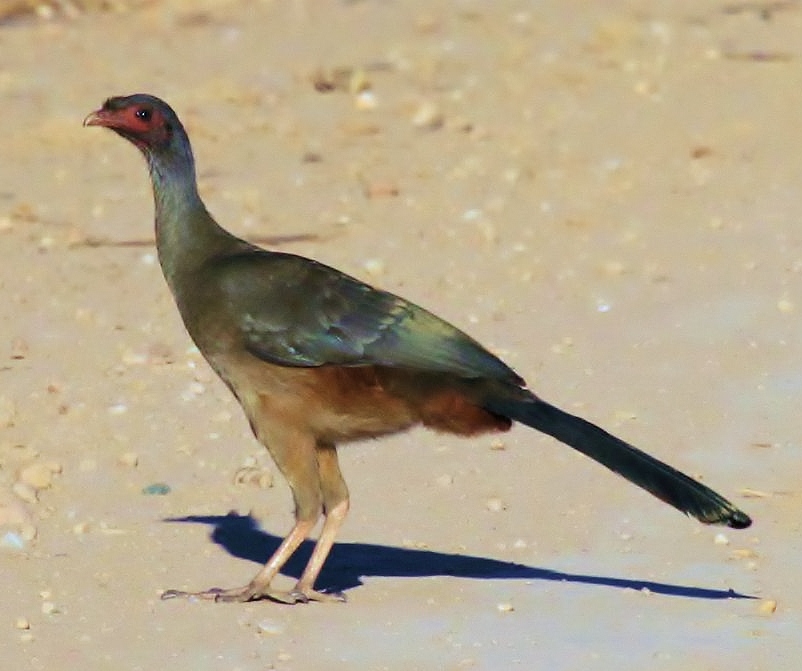
Chaco chachalaca

Ortalis canicollis

Photo by Ian Barker (Internet Bird Collection)

Common name:
Chaco chachalaca (en); aracuã-d0-Pantanal (pt); ortalide du Chaco (fr); charata (es); Chacoguan (de)


Taxonomy:
Order Galliformes
Family Cracidae


Range:
This South American birds are found in the Chaco region of south-eastern Bolivia, northern Argentina, Paraguay and south-western Mato Grosso, Brazil.


Size:
These birds are 50-56 cm long and weigh 480-600 g.


Habitat:
The Chaco chachalaca is mostly found in swamp forests and moist scrublands, but also in dry savannas, dry forests and plantations. They occur from sea level up to an altitude of 1.200 m.


Diet:
They mostly eat fruits, herbaceous leaves, seeds and flowers, but can also eat caterpillars and other invertebrates.


Breeding:
Chaco chachalacas breed in November-February. The nest is a shallow platform, made with sticks, stems and leaves, placed in a tree 2-4 m above the ground. There the female lays 2-4 eggs, which she incubates alone for 24 days. The chicks leave the nest very soon after hatching, but will receive food from parents for the first few days.


Conservation:
IUCN status - LC (Least Concern)
This species has a very large breeding range and is described as common. The population is declining due to habitat destruction caused by overgrazing, fires and wood extraction. It is also hunted and kept as a cage bird, but overall the Chaco chachalaca is not considered threatened at present.