Hiển thị các bài đăng có nhãn Strigidae. Hiển thị tất cả bài đăng

Thứ Bảy, 27 tháng 7, 2013

Eurasian scops-owl

Otus scops

Photo by Paul Cools (Internet Bird Collection)

Common name:
Eurasian scops-owl (en); mocho-d'orelhas (pt); petit-duc scops (fr); autillo europeo (es); zwergohreule (de)

Taxonomy:
Order Strigiformes
Family Strigidae

Range:
This species breeds in Morocco, Algeria and southern Europe as far north as northern France, Austria and Slovakia, than in the Ukraine, Belarus and into southern Russia and through the Middle East into central Asia as far east as Kazakhstan, north-western China and western Mongolia. Most population migrate south or south-west to winter along the Sahel belt in sub-Saharan Africa.

Size:
These birds are 16-20 cm long and have a wingspan of 53-63 cm. They weigh 90-145 g.

Habitat:
The Eurasian scops-owl is mostly found in both boreal and temperate deciduous forests, but also in scrublands, orchards, parks within urban area, agricultural areas with scattered trees and sometime also in open coniferous forests. This species is present from sea level up to an altitude of 3.000 m.

Diet:
They are mostly insectivorous, taking cicadas, grasshoppers, beetles, moths and flying ants. They also take woodlice, earthworms, mice and shrews, small birds and sometimes even amphibians and small reptiles.

Breeding:
Eurasian scops-owls breed in March-August. They are mostly monogamous, although some cases of polygyny are known to occur. They nest in a hole in an old tree trunk, sometimes using abandoned woodpecker nests, and may also use cavities in walls of old buildings, or under roofs of cabins in parks and gardens.There the female lays 3-6 white eggs which she mostly incubates alone for 24-25 days. The chicks are fed by both parents and leave the nest 21-29 days after hatching, before their plumage is completely grown. they start flying at 30-33 days of age but continue to be fed by the parents for another 5 weeks and sometimes migrate south together with their parents.

Conservation:
IUCN status - LC (Least Concern)
This species has a very large breeding range and the global population is estimated at 1-3 million individuals, although further validation of this estimate is needed. The population is suspected to be in decline owing to ongoing habitat destruction and fragmentation, and the use of pesticides.

Thứ Hai, 10 tháng 6, 2013

Brown fish-owl

Ketupa zeylonensis

Photo by Kata Mahakayi (Project Noah)

Common name:
brown fish-owl (en); bufo-pescador-castanho (pt); kétoupa brun (fr); búho pescador de Ceilán (es); wellenbrust-fischuhu (de)

Taxonomy:
Order Strigiformes
Family Strigidae

Range:
This species is found in southern Asia, from eastern Pakistan, throughout India, Nepal and Bangladesh, and into southern China, Vietnam and Malaysia.

Size:
These large owls are 48-57 cm long and weigh 1,1-2,5 kg.

Habitat:
The brown fish-owl is found in both moist and dry tropical forests, especially in open areas, and also in mangroves and plantation, but always near wetlands such as freshwater marshes, lakes and rivers. It is present from sea level up to an altitude of 1.900 m.

Diet:
They feed mainly on freshwater fishes, frogs, crabs and other crustaceans, but also some small mammals, birds, reptiles and occasionally carrion.

Breeding:
Brown fish-owls breed in November-March. The nest is made of sticks and placed in a rock crevice or a cleft in a bank. There the female lays 1-2 eggs which are incubated for about 38 days. The chicks fledge some 7 weeks after hatching.

Conservation:
IUCN status - LC (Least Concern)
This species has a very large breeding range and is reported to be generally uncommon.
The population is suspected to be in decline owing to ongoing habitat destruction and the use of rodenticides may also have a negative effect on this species.

Thứ Bảy, 27 tháng 4, 2013

Black-and-white owl

Ciccaba nigrolineata

Photo by L. Kay (Flickr)

Common name:
black-and-white owl (en); coruja-de-listas-pretas (pt); chouette à lignes noires (fr); cárabo blanquinegro (es); bindenhalskauz (de)

Taxonomy:
Order Strigiformes
Family Strigidae

Range:
This species is found from southern Mexico no northern Venezuela, western Colombia and north-western Ecuador.

Size:
These birds are 33-45 cm long and weigh 350-535 g.

Habitat:
Black-and-white owls are mostly found in tropical rainforests, especially in forests clearings and along forests edges. Also in mangroves, gallery forests, marshes, swamps, dry tropical forests, rural gardens and plantations. They are present from sea level up to an altitude of 1.500 m.

Diet:
They mainly hunt insects, such as beetles, cockroaches, grasshoppers, locusts and crickets, but also rodents, bats, birds and frogs.

Breeding:
Black-and-white owls are monogamous and extremely territorial. They breed during the local dry season, mostly in December-May. The nest in natural holes in live tree or stumps, or sometimes use abandoned stick nests from larger birds. There the female lays 2 white eggs, which she incubates alone for 15-35 days while the male brings her food. The chicks are fed by both parents and fledge 24-52 days after hatching.

Conservation:
IUCN status - LC (Least Concern)
This species has a large breeding range and the global population is estimated at 50.000-500.000 individuals. The population is suspected to be stable in the absence of evidence for any declines or substantial threats.

Thứ Bảy, 9 tháng 3, 2013

Elf owl

Micrathene whitneyi

(Photo from Wangchao)

Common name:
elf owl (en); mocho-duende (pt); chevêchette des saguaros (fr); mochuelo de los saguaros (es); elfenkauz (de)

Taxonomy:
Order Strigiformes
Family Strigidae

Range:
These North American birds are found in desert and arid areas of western Mexico and the southern United States, in Texas, New Mexico, Arizona and south-eastern California.

Size:
These tiny owls are 12,5-14 cm long and have a wingspan of about 27 cm. They weigh 35-55 g.

Habitat:
The elf owl is mostly found in arid deserts overgrown with saguaro cacti, thorny scrublands, and mesquite or deciduous riparian woodlands along rivers and streams. They are also found in temperate and moist forests and dry savannas within their range. These birds are present from sea level up to an altitude of 2.200 m.

Diet:
They mainly hunt scorpions and insects such as grasshoppers, locusts, mantids, fly larvae, caterpillars, centipedes, and cicadas. Also some small rodents and birds and occasionally small lizards and snakes.

Breeding:
Elf owls breed in April-July. They are typically monogamous and nest exclusively in old woodpecker cavities, either on trees or cacti, 3-10 m above the ground. The female lays 1-5 white eggs, which she incubates alone for 21-24 days while the male brings her food. The chicks are fed by the female with food the male brings to the nest. They fledge 28-33 days after hatching. Each pair raises a single brood per year.

Conservation:
IUCN status - LC (Least Concern)
This species has a relatively large breeding range and a global population estimated at 190.000 individuals. The population is suspected to be in decline owing to ongoing habitat destruction through deforestation. They are very dependent on woodpecker holes for nesting, so declines in woodpecker populations within their range will also have a negative impact on the elf owl.

Thứ Ba, 22 tháng 1, 2013

Long-eared owl

Asio otus

Photo by Greg Smith (Wikipedia)

Common name:
long-eared owl (en); bufo-pequeno (pt); hibou moyen-duc (fr); búho chico (es); waldohreule (de)

Taxonomy:
Order Strigiformes
Family Strigidae

Range:
This species is found throughout most of Europe, North America and Asia, between 20º N and 65º N. They are also found in north-western Africa.

Size:
These birds are 35-38 cm long and have a wingspan of 96-100 cm. They weigh 260-280 g.

Habitat:
The long-eared owl is found in a wide range of habitats, typically in areas of dense vegetation with nearby open areas for hunting. These include boreal, temperate and tropical forests, grasslands, scrublands, marshes and swamps, and plantations. They occur from sea level up to an altitude of 2.750 m.

Diet:
They hunt during the night, mainly taking small rodents, bats, moles, rabbits, small birds, insects, frogs and snakes.

Breeding:
Long-eared owl are typically monogamous, but polygyny has been recorded occasionally. They breed in February-July and nest on old stick nests of crows, ravens, magpies, buzzards or herons, located in a tree branch, 5-10 m above the ground. The female lays 3-8 glossy white eggs, which she incubates alone for 25-30 days while the males brings her food. The chicks are fed by the female while the males hunts for the whole family and move into branches near the nest after about 21 days, but only fledge 5 weeks after hatching. The chicks only become fully independent several weeks after fledging.

Conservation:
IUCN status - LC (Least Concern)
This species has an extremely large breeding range and a global population estimated at 1,5-5 million individuals. The long-eared owl has undergone a small decrease in North America, but it is not threatened at present.

Thứ Tư, 5 tháng 12, 2012

Striped owl

Pseudoscops clamator

Photo by Michel Giraud-Audine (Flickr)

Common name:
striped owl (en); coruja-orelhuda (pt); hibou strié (fr); lechuzón orejudo (es); schreieule (de)

Taxonomy:
Order Strigiformes
Family Strigidae

Range:
There are four different subspecies with disjunct ranges. P. c. forbesi is found from southern Mexico to Panama. P. c. clamator is found in Colombia, Venezuela, the Guyanas, extreme northern Brazil, Ecuador and north-eastern Peru. P. c. oberi is only found in the Caribbean islands of Trinidad and Tobago. P. c. midas is found from central Brazil and Bolivia down to central Argentina and Uruguay. The striped owl is absent from the Amazon basin.

Size:
These birds are 30-38 cm long and have a wingspan of 76-94 cm. Males are smaller and weigh 320-385 g while females weigh 400-555 g.

Habitat:
Striped owls are found in a variety of habitats, namely wet grasslands, along the edges of tropical moist forests and swamp forests, savannas, scrublands, fresh water wetlands, irrigated land, pastures, agricultural areas and even within urban areas. They are present from sea level up to an altitude of 1.400 m.

Diet:
They mainly feed on rodents, but also bats, large insects, medium-sized birds and sometimes also lizards.

Breeding:
The striped owl breeds in August-March. They nest on a scrape in the ground, usually
hidden among long grassy clumps or thick scrubs. The female lays 2-4 eggs, which she incubates alone for 33 days. The chicks are fed by the female while the male provides her with food, fledging 37-46 days after hatching. Usually only 1-2 chicks survive to fledging. They remain in the parents territory for another 4-5 months.


Conservation:
IUCN status - LC (Least Concern)
This species has a very large breeding range and a global population estimated at 500.000-5.000.000 individuals. The population is suspected to be stable in the absence of evidence for any declines or substantial threats.

Thứ Tư, 17 tháng 10, 2012

Northern white-faced owl

Ptilopsis leucotis

(Photo from Blogodisea)

Common name:
northern white-faced owl (en); mocho-de-faces-brancas-nortenho (pt); petit-duc à face blanche du nord (fr); autillo cariblanco norteño (es); nordbüscheleule (de)

Taxonomy:
Order Strigiformes
Family Strigidae

Range:
This African species is found along the Sahel belt, south of the Sahara desert, from Senegal, Guinea and Sierra Leone in the west to Sudan, Ethiopia and Somalia in the east.

Size:
These birds are 24-25 cm long and weigh 185-220 g.

Habitat:
The northern white-faced owl is found in dry savannas, riverine woodlands, scrublands and sometimes also in deserts and even within urban areas.

Diet:
They feed on invertebrates such as moths, crickets, beetles, scorpions, and spiders, as well as small vertebrates such as reptiles, birds and mammals, especially rodents and shrews.

Breeding:
Northern white-faced owls breed in May-November. They nest in natural holes or hollows and crevices in old trees, or old stick nests of larger birds in scrubs or trees, 2-8 m above the ground. There the female lays 2-4 shiny white eggs, which she incubates alone for 29-31 days while the male brings her food. The chicks are fed by both parents and fledge 27-32 days after hatching, but continue to receive food from the parents for another 2 weeks.

Conservation:
IUCN status - LC (Least Concern)
This species has a very large breeding range and is reported to be locally common to uncommon. The population is suspected to be stable in the absence of evidence for any declines or substantial threats.

Thứ Tư, 29 tháng 8, 2012

Great horned owl

bubo virginianus

Photo by Brendan Lally (Wikipedia)

Common name:
great horned owl (en); corujão-orelhudo (pt); gran-duc d'Amérique (fr); búho cornudo (es); Virginia-uhu (de)

Taxonomy:
Order Strigiformes
Family Strigidae

Range:
The great horned owl is widely distributed in the Americas, being found from Alaska and northern Canada, to Tierra del Fuego. They are only absent from the densest rain forests in Central America and the Amazon basin, as well as from the Caribbean islands.

Size:
These large owls are 43-64 cm long and have a wingspan of 91-153 cm. The males are smaller than the female, weighing 0,9-1,6 kg while the females weigh 1,4-2,5 kg.

Habitat:
The great horned owl is found in various habitats, namely deciduous,coniferous, and mixed forests, tropical rainforests, pampas, prairies, mountainous areas, deserts, subarctic tundra, rocky coasts, mangrove and swamp forests, and some urban areas. They are typically found at altitudes of 450-4.400 m.

Diet:
These powerful nocturnal predators take a wide range of prey, mostly mammals such as rodents, rabbits, skunks, armadillos, weasels, martens and bats, but also various birds, reptiles such as de snakes, turtles, lizards, and young alligators, amphibians such as frogs, toads, and salamanders and even fish, large insects, scorpions, centipedes, crayfish, worms, spiders, and road killed animals.

Breeding:
The great horned owls breed in December-June. They don't build nests, using abandoned nest of another birds, such as hawks or crows, typically in trees, cliffs, buildings or even on the ground. The female lays 1-5 white eggs, which are incubated by both parents for 27-37 days. The chicks leave the nest 6-7 weeks after hatching, but only become competent fliers at 10-12 weeks old and continue to receive food from their parents for another 2-3 months.

Conservation:
IUCN status - LC (Least Concern)
This species has an extremely large breeding range and is described as widespread and relatively common. The population trend is stable and in some areas the great horned owl may pose a threat to endangered species on which they may prey upon.

Thứ Ba, 22 tháng 5, 2012

Oriental scops-owl

Otus sunia

(Photo from World Bird Info)

Common name:
oriental scops-owl (en); mocho-d'orelhas-oriental (pt)petit-duc d'Orient (fr); autillo oriental (es); Orient-zwergohreule (de)


Taxonomy:
Order Strigiformes
Family Strigidae


Range:
This Asian species is found breeding from northern Pakistan and India, through Nepal and Bangladesh, into southern China and Indochina, and further north through eastern and north-eastern China and into Korea, Japan and Sakhalin in south-eastern Russia. The north-eastern populations migrate south to winter in south-eastern Asia, including Indonesia.


Size:
These birds are 17-21 cm long and have a wingspan of 42-53 cm. They weigh 75-95 g.


Habitat:
Oriental scops-owls are found in deciduous and mixed forests, and sometimes also in at the edge of taiga coniferous forests, but also in scrublands, pastures, plantations, parks and gardens. They occur from sea level up to an altitude of 1.500 m.


Diet:
They mainly eat insects and spiders, but also some small vertebrates like rodents and small birds.


Breeding:
The oriental scops-owl is monogamous and breeds in February-June. They nest in tree cavities, in holes in walls or sometimes in nest-boxes. The female lays 3-6 eggs, which are incubated for 24-25 days. There is no information regarding the fledging period, but the chicks of similar species fledge 4-6 weeks after hatching.


Conservation:
IUCN status - LC (Least Concern)
This species has a very large breeding range and, although the global population size has not been quantified, the oriental scops-owl is reported to be very abundant in some parts of its range. The population is suspected to be stable in the absence of evidence for any declines or substantial threats.

Thứ Sáu, 13 tháng 4, 2012

Rufous owl

Ninox rufa

(Photo from Internet Bird Collection)

Common name:
rufous owl (en); coruja-ruiva (pt); ninoxe rousse (fr); nínox rojizo (es); rostkauz (de)

Taxonomy:
Order Strigiformes
Family Strigidae

Range:
This species is found in northern Australia, New Guinea and the Aru Islands.

Size:
These birds are 46-57 cm long and have a wingspan of 100-120 cm. Females tend to be smaller than male, weighing 700-1.050 g while males weigh 1.050-1.300 g.

Habitat:
These birds are found in rainforests, gallery forests, forested gulleys, forest edges and wooded savannas. They are found from sea level up to an altitude of 2.000 m.

Diet:
These powerful hunters take a wide range of prey, from large insects like beetles and phasmids, to large birds including brush-turkeys, scrubfowl, frogmouths, kookaburras, white cockatoos, herons, ducks and parrots. They are also known to eat flying foxes and crayfish.

Breeding:
Rufous owls breed in June-September. They nest in a large hollow in the trunk or in a large branch, most often in a dead tree up to 30 m above the ground. The female lays 1-2 dull white eggs, which she incubates alone for 36-38 days. The chicks are fed by both parents and fledge about 50 days after hatching, but continue to depend on the parents for several months after fledging, and can remain with the parents until the next breeding season.

Conservation:
IUCN status - LC (Least concern)
This species has a large breeding range but is reported to be uncommon to rare. The population is suspected to be in decline owing to ongoing habitat destruction by the clearing of forests and increasing numbers of forest fires, and unsustainable levels of hunting.

Thứ Hai, 20 tháng 2, 2012

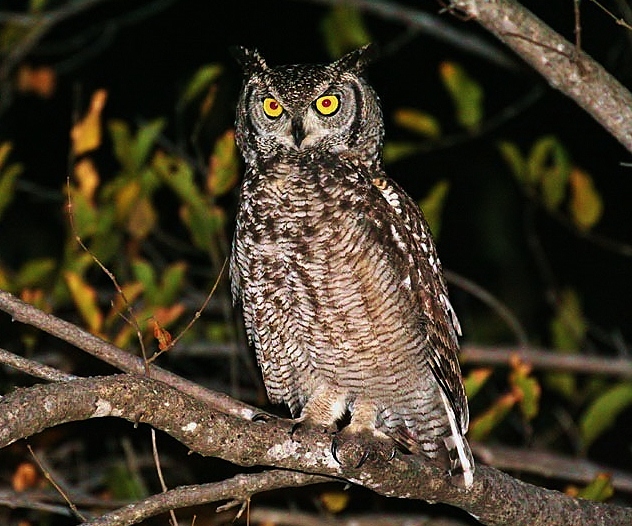
Spotted eagle owl

Bubo africanus

Photo by Johann du Preez (Fotopedia)

Common name:
spotted eagle owl (en); bufo-malhado (pt); grand-duc africain (fr); búho manchado (es); fleckenuhu (de)


Taxonomy:
Order Strigiformes
Family Strigidae


Range:
This species is widely distributed in sub-Saharan Africa, from Mauritania east to Sudan and Ethiopia, and all the way south to South Africa. It is also found in the Arabian Peninsula, in Saudi Arabia, Oman and Yemen.


Size:
These large owls are 45 cm long and have a wingspan of 100-140 cm. They weigh 480-850 g.


Habitat:
The spotted eagle owl occupies a wide range of habitats, including rocky desert outcrops, woodland and savannah, but generally prefer a mixture of grassland, scrubland and semi-open woodland, or rocky hills with scattered trees and bushes. They are found from sea level up to an altitude of 2.100 m.


Diet:
These birds have an extremely varied diet, including mammals such as rodents, hares and rabbits, bush-babies, fruit bats and mole rats; birds such as falcons, kites, francolins, hornbills, thick-knees and mousebirds; large poisonous snakes and smaller reptiles; amphibians; invertebrates such as spiders, insects, snails, crabs and millipedes; and even dead fish, and carrion.


Breeding:
Spotted eagle owls breed in July-December. The nest is a scrape on the ground, typically sheltered by a bush, grass or rocks. There the female lays 2-4 eggs white eggs which she incubates alone for 29-33 days. The chicks fledge 40-42 days after hatching, but remain with their parents while learning to hunt, only becoming fully independent 2-4 months later.


Conservation:
IUCN status - LC (Least concern)
This species has an extremely large breeding range and is reported to be widespread and common. The population is suspected to be stable in the absence of evidence for any declines or substantial threats.

Chủ Nhật, 8 tháng 1, 2012

Spotted owlet

Athene brama

Photo by Lip Kee (Flickr)


Common name:
spotted owlet (en); mocho-de-Brama (pt); chevêche brame (fr); mochuelo Brahmán (es); Brahmakauz (de)

Taxonomy:
Order Strigiformes
Family Strigidae

Range:
This Asian species is found from eastern Iran and Afghanistan, throughout Pakistan and India and into Nepal, Bangladesh, Myanmar, Laos and Vietnam.

Size:
These birds are 19-21 cm long and weigh 110-115 g.

Habitat:
Spotted owlets are generally found in heavily degraded patches of former tropical and subtropical forests, in pastures and arable land, and also in hot deserts. They are present from sea level up to an altitude of 1.500 m.

Diet:
They mostly eat insects, namely beetles and moths, and small rodents, but also bats, toads, small snakes, lizards, small birds, scorpions, earthworms and molluscs.

Breeding:
Spotted owlets breed in November-April. They nest in natural tree hollows, or in holes and cavities in human dwellings, where the female lays 2-5 white eggs. The eggs are incubated by both sexes for 25-30 days, and the chicks fledge 30-33 days after hatching. Each pair raises a single brood per year.

Conservation:
IUCN status - LC (Least concern)
This species has a very large breeding range and is reported to be common over most of its range. The population is suspected to be stable in the absence of evidence for any declines or substantial threats.