Hiển thị các bài đăng có nhãn Timaliidae. Hiển thị tất cả bài đăng

Chủ Nhật, 14 tháng 7, 2013

Taiwan yuhina

Yuhina brunneiceps

Photo by Robert Tec (Wikipedia)

Common name:
Taiwan yuhina (en); iuína-da-Formosa (pt); yuhina de Taiwan (fr); yuhina de Formosa (es);
braunkopfyuhina (de)


Taxonomy:
Order Passeriformes
Family Timaliidae

Range:
This species is endemic to Taiwan, being mostly found on the eastern side of the island.

Size:
These birds are 12-13 cm long and weigh 10-13 g.

Habitat:
The Taiwan yuhina is found in temperate and tropical moist forests, including broad-leaved and mixed broad-leaved and coniferous forests at altitudes of 1.000-3.000 m.

Diet:
They feed mostly on the nectar of Magnoliaceae, Elaeagnaceae and Salicaceae, also eating fruits, berries and flowers, and also some small insects.

Breeding:
Taiwan yuhinas breed in March-September. They are cooperative breeders, forming groups of 2-8 individuals, all of which help raise the chicks and defend the territory. The nest is bowl-shaped and made of moss, ferns, silver grass and roots, being fixed to a tree branch with spider webs. It is lined with ferns. The female lays 4-8 light green or blue eggs with yellowish-brown markings, which are incubated for 12-16 days. the chicks fledge 10-14 days after hatching. Each group may raise up to 3 broods per season.

Conservation:
IUCN status - LC (Least Concern)
This species has a relatively large breeding range and a global population estimated at 100.000-1.000.000 individuals. The population is suspected to be in decline owing to ongoing habitat destruction and fragmentation, but it is not considered threatened at present.

Thứ Năm, 6 tháng 6, 2013

Black-chinned laughingthrush

Strophocincla cachinnans

Photo by Niranjan Sant (Oriental Bird Images)

Common name:
black-chinned laughingthrush (en); zaragateiro-de-garganta-preta (pt); garrulaxe des Nilgiri (fr); chalátan de Nilgiri (es); zimtbrusthäherling (de)

Taxonomy:
Order Passeriformes
Family Timaliidae

Range:
This species is endemic to southern India, only being found in north-western Tamil Nadu, north-eastern Kerala and south-western Karnataka, predominantly in the Nilgiri Hills, and with a smaller disjunct population in the Palakkad-Siruvani Hills.

Size:
These birds are 20-24 cm long.

Habitat:
The black-chinned laughingthrush is mostly found in dense understory of tropical moist forests and also in scrublands, plantations and gardens at altitudes of 1.200-2.300 m.

Diet:
They feed on invertebrates, nectar, flowers, fruits and berries.

Breeding:
Back-chinned laughingthrushes breed in January-June. The nest is a deep cup made of fine twigs, moss, grass and dead leaves, and lined with moss roots, fibres, fine grass, wool, and fur. It is placed in a scrub or tree, usually 1-2 m above the ground. The female lays 2 greenish blue eggs with brown blotches, which are incubated by both parents for 16-17 days. The chicks are fed by both parents and fledge 15-18 days after hatching, but only become fully independent 3 weeks later.

Conservation:
IUCN status - EN (Endangered)
This species has a relatively small breeding range and a global population estimated by 2.500-10.000 individuals. The population is suspected to be declining at a moderate rate, owing to the degradation and loss of habitat. Many of the forests within their range are being converted into plantations, reservoirs, crops and human settlements. The indiscriminate use of inorganic pesticides may also be a problem. Having a mountainous distribution that is close to the maximum altitude within its range, this species is potentially susceptible to climate change.

Thứ Ba, 30 tháng 4, 2013

Giant babax

Babax waddelli

Photo by Johan van't Bosch (Oriental Bird Images)

Common name:
giant babax (en); zaragateiro-babaxe-gigante (pt); babaxe de Waddell (fr); babax gigante (es); riesenbabax (de)

Taxonomy:
Order Passeriformes
Family Timaliidae

Range:
This species is found in southern Tibet and marginally across the border into north-eastern Sikkim, India.

Size:
These birds are 31 cm long and weigh around 140 g.

Habitat:
The giant babax is found in moist tropical mountain forests and tropical high-altitude scrublands, particularly around stands of willow Salix sp., sea buckthorn Hippophae rhamnoides and prickly oak Quercus sp., and the edges of coniferous and mixed forests, at altitudes of 2.700-4.600 m.

Diet:
They feed on fruits, namely buckthorn, seeds and small insects.

Breeding:
Giant babaxes breed in May-July. They are cooperative breeders, with helpers assisting the breeding pair in tending the nest and the young. The nest is a rough cup, woven with thick twigs and peeled bark, and placed within a dense scrub, up to 2 m above the ground. There the female lays 2-4 eggs, which are incubated for 16-18 days. The chicks fledge 16-18 days after hatching.

Conservation:
IUCN status - NT (Near-Threatened)
This species has a restricted breeding range and the global population is estimated at 120.000 individuals. The population is suspected to be declining at a moderately rapid rate, due to
deforestation and habitat degradation.

Thứ Hai, 1 tháng 4, 2013

Yellow-eyed babbler

Chrysomma sinense

Photo by Sharad Agrawal (Facebook)

Common name:
yellow-eyed babbler (en); timali-de-olho-dourado (pt); timalie aux yeux d'or (fr); timalí ojigualdo (es); goldaugentimalie (de)

Taxonomy:
Order Passeriformes
Family Timaliidae

Range:
This species is found is found in Pakistand and India, and through Nepal and Bangladesh into southern China, Thailand and Vietnam.

Size:
These birds are 17-18 cm long and weigh 12-20 g.

Habitat:
The yellow-eyed babbler is found in grasslands and scrublands, along the margins of rivers and fresh water wetlands, and rice paddies and other arable land.

Diet:
They feed on various adult and larval insects, particularly caterpillars.

Breeding:
Yellow-eyed babblers breed in April-September. The nest is a compact cup made of grasses, bark and spider webs, woven around an upright twig or stem of a scrub or sometimes among reeds. The nest in lined with fine grasses and roots. The female lays 4-5 pinkish-white eggs with red streaks. The eggs are incubated by both sexes for 12-14 days. The chicks are fed by both parents and fledge 12-13 days after hatching.

Conservation:
IUCN status - LC (Least Concern)
This species has a very large breeding range and is described as uncommon and local in Pakistan, local to fairly common in Nepal and widespread and locally common in India. The population is suspected to be stable in the absence of evidence for any current declines or substantial threats.

Thứ Hai, 18 tháng 2, 2013

Puff-throated babbler

Pellorneum ruficeps

Photo by P. Supat (Internet Bird Collection)

Common name:
puff-throated babbler (en); zaragateiro-de-peito-estriado (pt); akalat à poitrine tachetée (fr); tordina pechiestriada (es); streifenbrust-erdtimalie (de)

Taxonomy:
Order Passeriformes
Family Timaliidae

Range:
This species is found in southern Asia, in southern India, in northern India, Nepal and Bhutan, and Myanmar and southern China into Vietnam, Thailand and Malaysia.

Size:
These birds are 15 cm long.

Habitat:
The puff-throated babbler is found in scrublands, bamboo thickets, tropical moist forests and plantations.

Diet:
They mainly forage on the undergrowth and the forest floor, taking various insects and other invertebrates.

Breeding:
Puff-throated babblers breed in March-August, mainly during the local rainy season. The nest is a dome of leaves and twigs with an entrance on the side, usually placed at the base of a scrub with the entrance pointing downwards when in sloppy ground. There the female lays 2-5 pale greenish or yellowish eggs with reddish brown and grey speckles or spots. There is no information regarding the length of the incubation period, but the chicks fledge 12-13 days after hatching.

Conservation:
IUCN status - LC (Least Concern)
This species has a very large breeding range and is described as generally common. The population is suspected to be stable in the absence of evidence for any current declines or substantial threats.

Thứ Sáu, 18 tháng 1, 2013

Rusty-fronted barwing

Actinodura egertoni

Photo by Raj Kamal Phukan (Oriental Bird Images)

Common name:
rusty-fronted barwing (en); asa-malhada-ruivo (pt); actinodure d'Egerton (fr); actinodura de Egerton (es); rotstirnsibia (de)

Taxonomy:
Order Passeriformes
Family Timaliidae

Range:
This species is found in the foothills of the Himalayas, in Nepal, Bhutan, north-eastern India, western Myanmar and marginally across the border into China.

Size:
These birds are 22-24 cm long and weigh 33-38 g.

Habitat:
The rusty-fronted barwing is found in moist tropical forests, especially secondary forests and deciduous forest with a dense understorey, at altitudes of 600-2.600 m.

Diet:
They mainly eat invertebrates such as grasshoppers and ants, but complement their diet with berries, figs and seeds.

Breeding:
Rusty-fronted barwings breed in April-July. The nest is a cup-shaped structure made of ferns, bamboo, leaves and fine vegetable fibres, lined with moss and small rootlets. It is placed in a scrub or small tree up to 6 m above the ground. The female lays 3-4 pale blue eggs with brown markings. There is no information regarding the incubation and fledging periods.

Conservation:
IUCN status - LC (Least Concern)
This species has a relatively large breeding range and is described as rare and local in central Nepal, frequent in Bhutan and locally fairly common in India. The population is suspected to be in decline owing to ongoing habitat destruction and fragmentation, but it is not considered threatened at present.
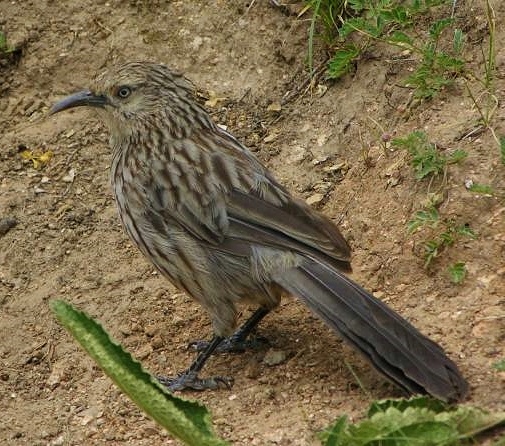
Chủ Nhật, 9 tháng 12, 2012

Black-headed sibia

Heterophasia desgodinsi

Photo by Hung Do Manh (Oriental Bird Images)

Common name:
black-headed sibia (en); sibia-de-cabeça-preta (pt); sibia de Desgodins (fr); sibia cabecinegra (es); schwarzkopftimalie (de)

Taxonomy:
Order Passeriformes
Family Timaliidae

Range:
This species is found in in northern Myanmar, southern China, Laos and Vietnam.

Size:
These birds are 21,5-24,5 cm long.

Habitat:
The black-headed sibia is found tropical and sub-tropical moist mountain forests, at altitudes of 800-2.900 m.

Diet:
They forage on the forest canopy, or occasionally near the ground, taking insects, grubs, berries and also nectar.

Breeding:
Black-headed sibias breed in April-August. The nest is made of plant fibres and placed in a fork in a tree. The female lays 1-3 blue eggs with reddish-brown blotches, which she incubates alone for 14-16 days. The chicks are fed by both parents and fledge 15-17 days after hatching.

Conservation:
IUCN status - LC (Least Concern)
This species has a large breeding range and is described as common in China, but uncommon in Vietnam. The population is suspected to be in decline owing to ongoing destruction and fragmentation of their forest habitats.

Thứ Tư, 31 tháng 10, 2012

Snowy-cheeked laughingthrush

Garrulax sukatschewi

Photo by Chong Cha (Flickr)

Common name:
snowy-cheeked laughingthrush (en); zaragateiro-de-Sukatschev (pt); garrulaxe de Sukatschev (fr); charlatán de Sukatschev (es); Kansuhäherling (de)

Taxonomy:
Order Passeriformes
Family Timaliidae

Range:
This species is endemic to China, only being found in the south-western parts of the country, in
the Min Shan mountains in southern Gansu province and adjacent parts of north-central Sichuan province.


Size:
These birds are 27-31 cm long.

Habitat:
The snowy-cheeked laughingthrush is found in temperate forests, including mixed, evergreen and broadleaved, usually where there is undergrowth of bamboo and scrubs. Also in grasslands and near rivers and streams, at altitudes of 2.000-3.500 m.

Diet:
They forage on the ground, among the moss and leaf-litter, taking invertebrates, seeds and berries. 

Breeding:
These birds breed in May-July. The nest is a bowl, placed 2-3 m above the ground on a tree, most often a spruce. The female lays 2-5 eggs which are incubated by both parents for 14 days. The chicks are raised by both parents and fledge 16-18 days after hatching.

Conservation:
IUCN status - VU (Vulnerable)
The snowy-cheeked laughingthrush has a small and severely fragmented breeding range. The population is estimated at 2.500-10.000 individuals, and moderate and on-going declines are suspected, owing to the rate of degradation of habitats across the species's range. Forest cover has declined rapidly in Sichuan since the late 1960s, through exploitation for timber and clearance for cultivation and pasture, resulting in habitat loss and fragmentation for this species.

Thứ Năm, 27 tháng 9, 2012

Streak-throated barwing

Actinodura waldeni

Photo by Yathin Krishnappa (Mango Verde)

Common name:
streak-throated barwing (en); asa-malhada-de-Walden (pt); actinodure de Walden (fr); actinodura de Yunán (es); Yünnansibia (de)

Taxonomy:
Order Passeriformes
Family Timaliidae

Range:
This species is found in Myanmar, Bangladesh, Bhutan and marginally across the border into southern China and northern India.

Size:
These birds are 20-22 cm long and weigh 39-56 g.

Habitat:
The streak-throated barwing is found in tropical and sub-tropical moist mountain forests and scrublands, at altitudes of 1.700-3.300 m.

Diet:
They are omnivorous, eating insects and molluscs, but also various fruits, seeds and visiting flowers to take their nectar.

Breeding:Streak-throated barwings breed in April-October. The nest is a compact cup made of grasses, moss and lichens, lined with fine rootlets. It is typically placed in a tree sapling, not far from the ground. There the female lays 2 brownish-red eggs with grey spots. There is no available information regarding the incubation and fledgling periods.

Conservation:
IUCN status - LC (Least Concern)
This species has a large breeding range and is described as as locally fairly common in India and very rare in China. The population is suspected to be in decline owing to ongoing habitat destruction and fragmentation.

Thứ Sáu, 24 tháng 8, 2012

Red-tailed laughingthrush

Garrulax milnei

Photo by David Blank (Animal Diversity Web)

Common name:
red-tailed laughingthrush (en); zaragateiro-de-cauda-vermelha (pt); garrulaxe à queue rouge (fr); charlatán colirrojo (es); rotschwanzhäherling (de)

Taxonomy:
Order Passeriformes
Family Timaliidae

Range:
The red-tailed laughingthrush is found in south-eastern Asia, from southern China to Myanmar, Laos, northern Thailand and Vietnam.

Size:
These birds are 25-28 cm long and weigh 100-130 g.

Habitat:
The red-tailed laughingthrush is mostly found in tropical and sub-tropical moist forests, but also in temperate forests and high altitude grasslands and scrublands. They ar present at altitudes of 610-2.500 m.

Diet:
They mainly feed on seeds and small fruits, but will also take some insects and other invertebrates.

Breeding:
Red-tailed laughingthrushes breed in April-July. They nest in an open cup made of sticks and grasses, placed in dense forests undergrowth. The female lays 2-4 white eggs with reddish-brown or black dots, which are incubated for 13-16 days. The chicks fledge 35-45 days after hatching.

Conservation:
IUCN status - LC (Least Concern)
This species has a very large breeding range, but is described as rather uncommon to rare. The population is suspected to be in decline owing to ongoing habitat destruction and fragmentation, but it is not considered threatened at present.

Thứ Tư, 18 tháng 7, 2012

Rusty-cheeked scimitar-babbler

Pomatorhinus erythrogenys

Photo by Nitin Srinivasamurthy (Oriental Bird Images)

Common name:
rusty-cheeked scimitar-babbler (en); zaragateiro-de-simitarra-ferrugíneo (pt); pomatorhin à joues rousse (fr); cimitarra carirrufa (es); rotwangensäbler (de)


Taxonomy:
Order Passeriformes
Family Timaliidae


Range:
This species is found in the foothills of the Himalayas, from north-eastern Pakistan to Nepal, Bhutan and northern Myanmar and Thailand.


Size:
These birds are 27-28 cm long and weigh 50-60 g.


Habitat:
They are mainly found in dense scrublands and forest edges, often near human settlements.


Diet:
Rusty-cheeked scimitar-babbler forage on the ground among leaf litter, taking adult and larval insects, molluscs, crustaceans, chilopods and earthworms. This mainly carnivorous diet is sometimes supplemented with berries and fruits.


Breeding:
These birds breed in April-June. The nest is a rough, loosely built structure made of dead leaves, grasses, bamboo leaves and ferns, placed on a steep embankment or at the base of a tree. There the female lays 2-4 white eggs with dark spots, which are incubated by both sexes for 14-16 days. The chicks fledge 2 weeks after hatching, but continue to receive food from parents for another month.


Conservation:
IUCN status - LC (Least Concern)
This species has a relatively large breeding range and is described as common. The population is suspected to be stable in the absence of evidence for any current declines or substantial threats.

Thứ Sáu, 1 tháng 6, 2012

Giant laughingthrush

Garrulax maximus

Photo by Philip He (Oriental Bird Images)

Common name:
giant laughingthrush (en); zaragateiro-gigante (pt); garrulaxe géant (fr); charlatán gigante (es); riesenhäherling (de)


Taxonomy:
Order Passeriformes
Family Timaliidae


Range:
This species is found in south-western China and in northern India.


Size:
These birds are 32-36 cm long.


Habitat:
The giant laughingthrush is found in open broadleaf and mixed broadleaf-coniferous forests and bamboo scrublands in broadleaf evergreen forests, up to an altitude of 4.100 m.


Diet:
They mostly eat insects, but may also eat fruits and seeds.


Breeding:
Giant laughingthrushes breed in April-July. The nest is a shallow bowl, made of twigs and lined with bamboo strands and stems of various other plants. There the female lays 1-3 blue eggs which are incubated by both parents for around 2 weeks. The chicks are fed by both parents and fledge 17-18 days after hatching.


Conservation:
IUCN status - LC (Least Concern)
This species has a large breeding range and, although the global population size has not been quantified, it is described as locally common. The population is suspected to be in decline owing to ongoing habitat destruction and fragmentation.

Thứ Tư, 25 tháng 4, 2012

Silver-eared mesia

Leiothrix argentauris

Photo by J.J. Harrison (Wikipedia)

Common name:
silver-eared mesia (en); rouxinol-de-faces-prateadas (pt); léiothrix à joues argent (fr); leiotrix cariblanco (de); silberohr-sonnenvogel (de)


Taxonomy:
Order Passeriformes
Family Timaliidae


Range:
This Asian species is found around the Himalayas, in Nepal, northern India and in western and south-western China, and through Bangladesh and Myanmar, across Indochina and down to Indonesia.


Size:
These birds are 16-18 cm long and weigh 15-30 g.


Habitat:
They are mostly found along the edges of moist broadleaved forests, in scrublands and plantations. They occur from sea level up to an altitude of 2.600 m.


Diet:
They eat both insects and various fruits and berries.


Breeding:
Silver-eared mesias are monogamous and may mate for life. The nest is an open cup, made of grasses, twigs, mosses and plant fibres, and lined with feathers and soft grasses. The nest is usually hidden in dense scrubs. The female lays 2-4 pale blue eggs with brown speckles, which she incubates alone for 13-14 days. The chicks are fed by both parents and fledge 12-14 days after hatching, but only become fully independent 2-4 weeks later. Each pair may raise 2-3 clutches per year.


Conservation:
IUCN status - LC (Least concern)
This species has a very large breeding range and, although the global population size has not been quantified, it is described as generally common, although locally rare in Nepal. The population is suspected to be in decline owing to ongoing habitat destruction and fragmentation, but it is not considered threatened at present.

Chủ Nhật, 18 tháng 3, 2012

Common babbler

Turdoides caudatus

Photo by Rajiv Lather (Birding in India and South Asia)

Common name:
common babbler (en); zaragateiro-de-cauda-comprida (pt); cratérope indien (fr); turdoide indio (es); langschwanzdrossling (de)


Taxonomy:
Order Passeriformes
Family Timaliidae


Range:
This Asian species is found from Iraq, Kuwait and Iran, through Afghanistan and Pakistan, across India and into Nepal.


Size:
These birds are 23 cm long and weigh 30-40 g.


Habitat:
The common babbler is mostly found in arid and semi-arid areas, often using Tamarix and other dry scrublands, dry grasslands, rocky areas and also orchards, rural gardens and other plantations. They are found from sea level up to an altitude of 2.100 m.


Diet:
They mostly forage on the ground, eating insects and other small invertebrates.


Breeding:
Common babblers can breed all year round, but with a peak in March-September. They live in small social groups of 6-11 birds, in which only 1, or sometimes 2 pairs breed, while the other individuals help feeding the chicks and defending against predators. The breeding pair builds the nest, a deep, compact cup, neatly made using grass roots and stems. The nest is placed in a small thorny bush, 0,5-2,5 m above the ground. The female lays 2-5 pale blue eggs, which are incubated for 13-16 days. The chicks fledge 13-18 days after hatching. They raise 2-3 broods per year.


Conservation:
IUCN status - LC (Least concern)
This species has a very large breeding range and is reported to be fairly common. The population is suspected to be stable in the absence of evidence for any current declines or substantial threats.

Chủ Nhật, 12 tháng 2, 2012

Black chinned yuhina

Yuhina nigrimenta


Common name:
black-chinned yuhina (en); iuína-de-garganta-preta (pt); yuhina à menton noir (fr); yuhina barbinegra (es); meisenyuhina (de)


Taxonomy:
Order Passeriformes
Family Timaliidae


Range:
This Asian species is found from northern India, Nepal and Bhutan, through Bangladesh, and into southern China, Myanmar, Cambodja and Vietnam.


Size:
These birds are 10 cm long and weigh 9-10 g.


Habitat:
Black-chinned yuhinas are found in tropical and sub-tropical moist forests, at altitudes of 200-2.800 m.


Diet:
They mostly eat seeds, fruits and small insects.


Breeding:
Black-chinned yuhinas build a cup-shaped nest in a scrub or climbing plant, where the female lays 1-3 eggs. The eggs are incubated for 16 days and the chicks fledge 14-17 days after hatching.


Conservation:
IUCN status - LC (Least concern)
This species has a very large breeding range and is described as common to rare. The population is suspected to be in decline owing to ongoing habitat destruction and fragmentation.

Thứ Năm, 29 tháng 12, 2011

White-collared yuhina

Yuhina diademata

Photo by David Blank (Animal Diversity Web)


Common name:
white-collared yuhina (en); iuína-de-diadema (pt); yuhina à diadème (fr); yuhina diademada (es); diademyuhina (de)

Taxonomy:
Order Passeriformes
Family Timaliidae

Range:
This Asian species is found in China, Myanmar and Vietnam.

Size:
This large yuhina is 14,5-19 cm long and weighs 19-24 g.

Habitat:
White-collared yuhinas are mostly found in tropical and subtropical moist, mountain forests, especially open broadleaved evergreen forests, but also in secondary growth and tee plantations. They are present at altitudes of 800-3.600 m.

Diet:
They forage in pair, or in small flocks, mostly eating insects but also seeds and rhododendron nectar.

Breeding:
White-collared yuhinas breed in May-September. They build a cup-shaped nest made of dry leaves, grass and roots, plastered with cobweb or moss. The nest is placed in a bush, grass or small tree, 0,2-1,5 m above the ground. There the female lays 2-3 pale green eggs with rust-coloured spots which she incubates alone for 14 days. The chicks are fed by both parents and fledge 13 days after hatching.

Conservation:
IUCN status - LC (Least concern)
This species has a very large breeding range and, although the global population size has not been quantified, it is described as common to very common in China and locally fairly common in Myanmar and Vietnam. The population trend is difficult to determine because of uncertainty over the impacts of habitat modification on population sizes.